
Grand Junction Resident Lookup Coverage
A person can appear in a directory, assessor location, tax mailing field, voter system, cemetery portal, city permit, court docket, public notice, newspaper, business filing, or license record. Those systems do not use the same date or relationship. The coverage table keeps a name result attached to the record it actually answers.
| Record | What it confirms | Where | Access |
|---|---|---|---|
| Assessor parcel | Parcel, situs, mailing, displayed owner fields, use, legal description | Mesa Assessor | Public lookup; report date and disclaimer |
| Recorded instrument | Filed party, date, document type, legal description, image lead | Mesa Landmark | Free view; copies and certification fees |
| Voter registration | Individual lookup and polling route; selected county report fields | Colorado SOS and Mesa Elections | First, last, ZIP, birthday; confidentiality limits |
| Court docket or file | Hearing, case number, party field, type, and official-file route | 21st Judicial District or city court | Docket fields public as displayed; file restrictions |
| Birth or death record | Eligible certified or verification record and event facts | Mesa Public Health or CDPHE | ID, eligibility, interest, and fee required |
| Directory or newspaper | Historical address, spouse, occupation, office, or notice clue | Library, Ancestry, CHNC | Microfilm, image, or licensed database |
| Cemetery | Name, cemetery, and interment-year clue | Grand Junction cemetery portal | Public search; digitization is ongoing |
A lookup result is strongest when two independent fields agree. Match a full name with a middle initial, compatible date, exact street or parcel, spouse or partner, organization, case number, or another record-specific identifier. Keep the relationship to the address as situs, mailing, recorded party, directory listing, voter registration, cemetery, or incident location.
Choosing the Right Grand Junction Record
Start with the question, not the most familiar database. A current parcel question begins with the assessor and GIS. A hearing question begins with the Colorado Judicial Branch docket. An eligible certificate question goes to Public Health or the state. A former classmate or past resident may require the library, newspaper, city directory, or cemetery. A business clue goes to the Colorado Secretary of State or DORA, and a municipal record may belong in City Clerk WebDrawer.
Use a source ladder when a name is all that remains: name plus address, address plus parcel, parcel plus recorded party, surname plus year and directory, or name plus case number. Search surname-first and first-last forms, maiden or former names, initials, hyphenation, North or South prefixes, and house number variants. A same-name result stays unresolved until the date and relationship fit.
Do not collapse a directory occupant, parcel owner, tax addressee, voter, recorded grantor, cemetery entry, or licensee into one identity. Record the source URL, query fields, search date, returned identifier, interpretation, and next custodian.
- Docket
- A court hearing calendar or summary. It is not the full case file or proof of a final disposition.
- Index versus image
- An index points to a record. The image or official copy carries the document text and may have different access limits.
- Certified copy
- A custodian-issued copy with a certification statement. It is different from a screen view or a plain photocopy.
- Relationship to address
- The field that states whether a person is tied to a location as owner, mailing addressee, recorded party, voter, directory entry, or another dated role.
Mesa Docket Search by Party
Mesa County is in Colorado's 21st Judicial District. The state docket portal can filter by judicial district, county, courthouse, court type, division, date range or specific date, case year, class, sequence, party type, business name, attorney, or bar number. At least one filter beyond the date is required. A party search should use a name plus a county or case clue whenever possible.
| Docket control | Observed choice or result |
|---|---|
| Party | Individual or business, first and last name, or business name. |
| Case | Year, class, sequence, case number, court type, division, and county. |
| Date | Date range or specified date, with a second filter required. |
| Attorney | Attorney name or bar-number choice, then the related name field. |
| Result row | Date, time, duration, name, case number, hearing type, location, appearance type, courtroom. |
A captured public row showed a hearing date and time, duration, case number, hearing type, Mesa County location, and courtroom. The state portal displayed Export Results and Printable controls with 20 rows per page. Those fields identify a scheduled hearing record. They do not establish what happened, what an allegation means, or what the final disposition was.
Open the Colorado court public-record access guide before viewing the capture below; it shows the boundary between the online docket and the official file.
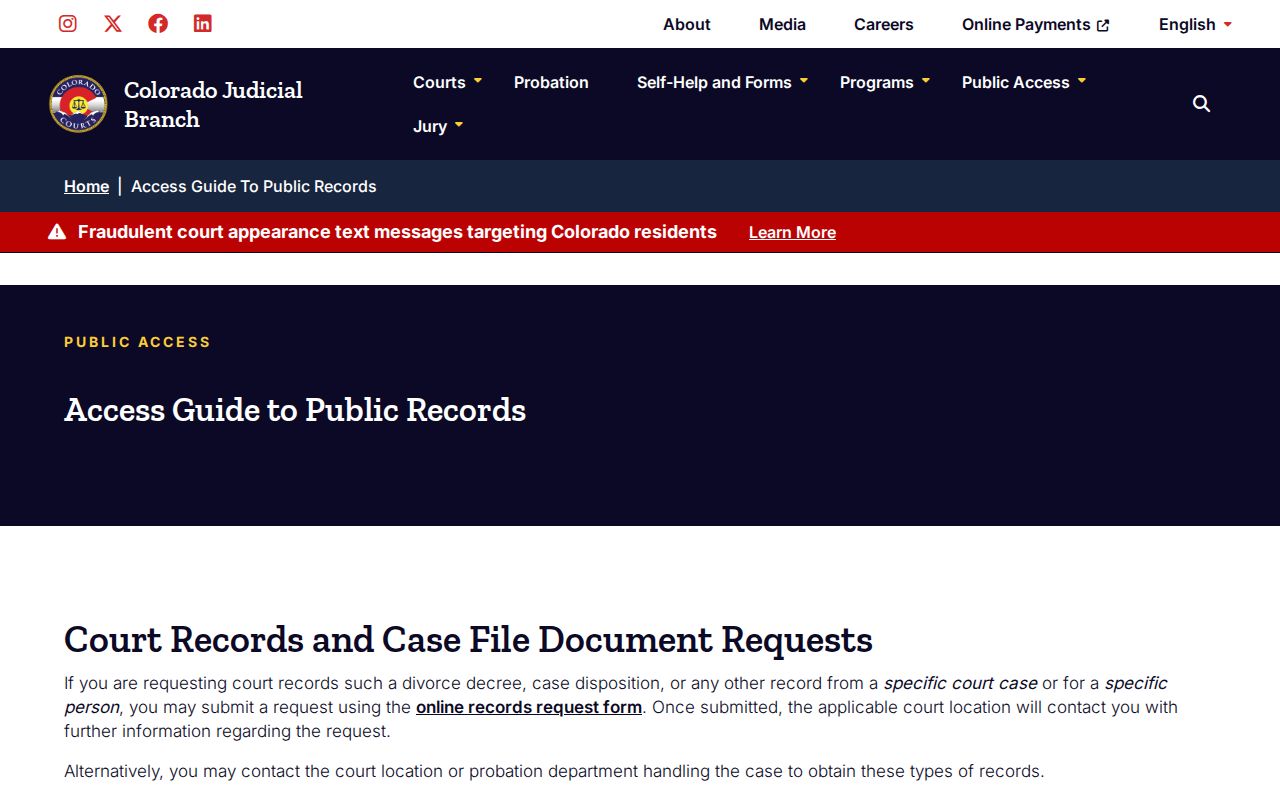
Keep case type, county, case number, hearing date, and the result's own wording.
Note: A docket is a hearing-calendar lead, so a name match needs a case number and a custodian check before it is treated as the right person.
Grand Junction Court Files and Fees
The official court-record request form asks for the applicant's contact information, case number, type, year, county, party name, date of birth or other identifiers, and the document choice. It offers family, criminal, civil, probate, divorce, custody, support, petition, complaint, disposition, sentence, protection-order, judgment, transcript, will, trust, register-of-action, certified, and exemplified choices. Restricted, juvenile, suppressed, and protected records can require identification or supporting proof.
The form lists electronic or coin copies at $.25 per page, paper or court copies at $.75, a nonparty research or register-of-action charge, research and redaction after the first hour at $30 per hour in 15-minute units, and separate certificate, certified-copy, and postage fees. Its stated processing estimate is three to five business days. Confirm the live form before paying because fees and processes can change.
Grand Junction Municipal Court is separate from the county district-court route. Its public page provides discovery, sealing, warrant-clearing, financial, cost, fee, and bond material. The municipal payment and search portal exists, but exact public name and case fields were not verified in the text research. Do not treat it as a complete county docket.
Open the Grand Junction Municipal Court search route before viewing the capture below; it belongs to the city-court branch.
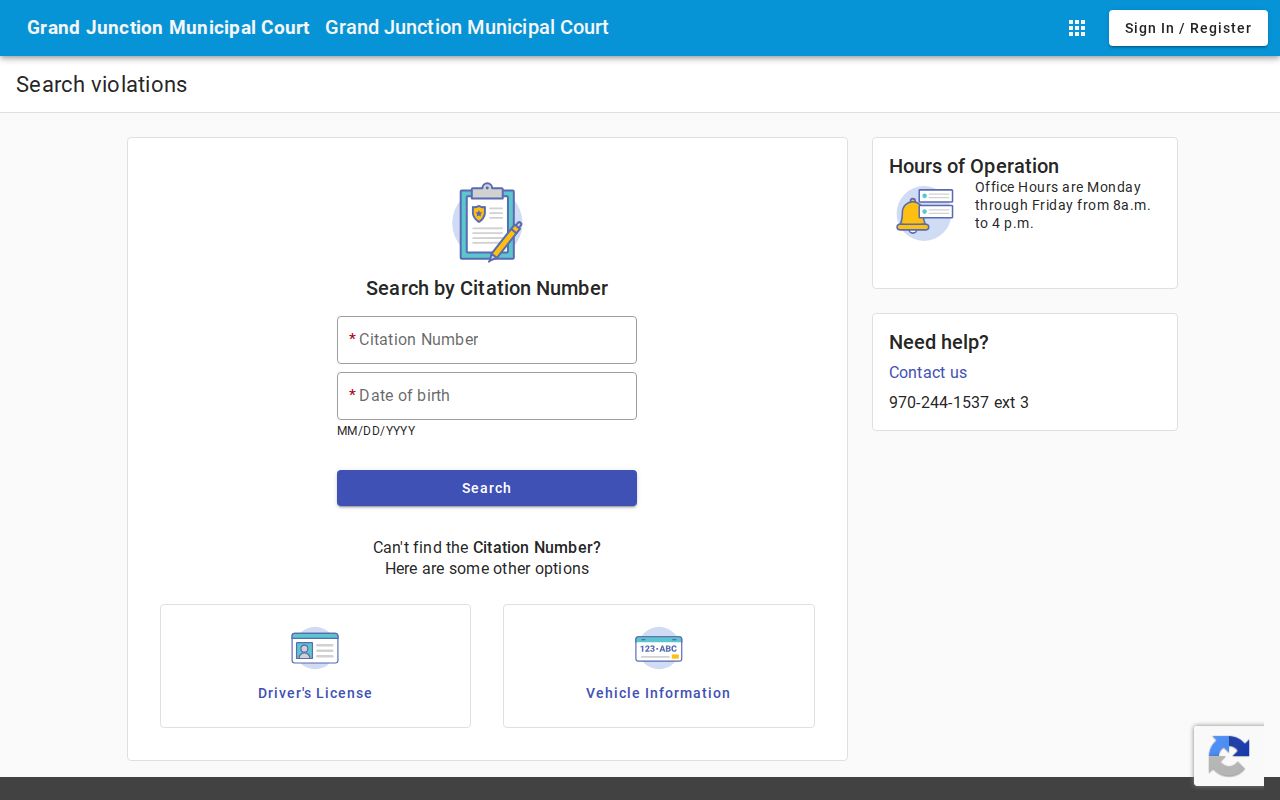
Use the city's court contact for a record question and the 21st Judicial District for a county or state court question.
For a criminal-history lead, the CBI Internet Criminal History Check is a Colorado-only name and date-of-birth search with a listed $6 fee, juvenile, traffic, and sealed-record exclusions, and a warning that multiple matches may need identity reconciliation. A name-only result remains a lead.
Reading a Grand Junction Lookup Result
A useful result inventory records the fields a reader can see and the fields it cannot answer. For a Mesa docket, note the portal, search filters, result date, hearing time, duration, case number, hearing type, location, appearance type, courtroom, export or print control, and page count. For an assessor result, note parcel, account, location, mailing, owner display, use, legal description, report date, and previous or associated parcel. For a directory result, note publication, year, page, street, name, occupation, spouse or partner, and image quality.
Use the same-name trap as a reason to slow down. A middle initial can separate two people. A former road name can connect the same address across time. A record date can differ from an event date. An organization, trust, estate, or office can resemble an individual name. Keep a confidence label: direct match, strong cross-source match, possible match, or unresolved.
| Field to log | Example of its use |
|---|---|
| Source and search date | Shows which live system and retrieval moment produced the clue. |
| Record identifier | Case number, reception number, parcel, account, interment entry, or license number. |
| Relationship | Parcel owner field, recorded party, directory occupant, voter, cemetery, or event location. |
| Second independent field | Address, date, spouse, organization, district, or middle initial that tests identity. |
| Stopping point | Index only, restricted file, login screen, protected address, or official request route. |
That stopping point is part of the answer. A public name without an image, a parcel without occupancy, or a docket without disposition should be labeled as such.
Voter Lookup as a Grand Junction Check
The Colorado self-lookup asks for first name, last name, ZIP, and birthday. The state says a former ZIP can help after a move, but a confidential record or under-18 record may not locate. The tool can support review or update, ballot, and polling-place actions. It is not a public bulk directory.
Mesa County's report form is a separate route for registered lists, precinct and district information, voter history, walking lists, and turnout-related reports. It asks for requester details, report code, district or precinct, party, status, phone inclusion, delivery, and payment. Ordinary lists omit confidential voters. A special-district certified list has its own charge and confidentiality treatment.
Use voter data to test a particular identity, not to fill every blank in an address trail. The Colorado Secretary of State FAQ distinguishes public name, address, party, phone-if-provided, birth-year, and voting-history fields from protected identifiers, birth-date components, signatures, email, and confidential addresses. Ballot choice is not public registration data.
Birth, Death, Marriage, and Divorce
Colorado vital statistics are confidential under C.R.S. §25-2-117. Mesa Public Health requires identity and eligibility proof, and its 2026 route lists $25 for the first certified copy and $20 for an additional copy. Birth access routes cover Colorado counties through the county or state system. Mesa death coverage is described from 1910 to the present, with statewide death coverage from 1975 to the present.
The Mesa death form separates applicant relationship and reason, asks for the decedent's name and death date, and offers standard, verification, or legal copy choices. Payment can be by credit card or check, with no cash, through the stated mail or email routes. Eligibility is relationship-specific. A surname, street, or shared address is not proof of eligibility.
Marriage-license applications belong to the county clerk and are distinct from a certificate or status claim. The Mesa license fee is listed as $30 cash-only, and the license is valid for 35 days in Colorado. Divorce records belong to the 21st Judicial District. Adoption information and the Colorado Voluntary Adoption Registry have separate eligibility, consent, notarization, and identification rules.
Use an eligible certificate to prove an event, not to expose a private address. For historical clues, route through newspapers, cemetery records, library collections, and the State Archives before asking the formal custodian for a restricted copy.
Finding Historical Grand Junction Residents
For a former resident, start with the Mesa County Libraries genealogy guide, city directories, Daily Sentinel or Grand Junction News microfilm, cemetery search, Sanborn maps, and city survey PDFs. A directory can show a dated address, occupation, spouse, office, business partner, or forwarding note. An obituary can add a date, spouse, funeral place, or former address. A cemetery result can identify an interment, but the city warns that digitization is ongoing.
The 1912 James Bucklin example at 634 N. 5th shows why an office clue and home clue must be separated. The library material connects Bucklin and Tupper with an office in the Grand Valley National Bank Building, while the issue lacks an address section. Search a nearby year, inspect the page image, and compare a historic address with the street index, parcel history, or Sanborn sheet.
The reviewed Colorado County Marriages collection on FamilySearch does not list Mesa County. Check county coverage instead of assuming a statewide title includes Grand Junction. A useful historic trail ends at a page, sheet, case, deed, cemetery entry, or archive identifier.
Legal Limits on a Grand Junction Resident Lookup
Public access has boundaries. Court material can be juvenile, sealed, suppressed, protected, or redacted. Vital records require direct or tangible interest and identity. Voter confidentiality and the Colorado Address Confidentiality Program can hide a lawful address. DMV data is restricted. CORA and CCJRA requests go to the custodian and do not require an office to create a new record or answer a broad question.
Use the narrowest request that answers the personal research question. Ask for inspection before ordering copies. Log the request date, confirmation, response date, fee estimate, delivery, and redactions. If the trail ends at a protected field, stop there. A protected result is not proof that a person is absent or that an address is false.
Lawful use only. A Grand Junction resident lookup is for lawful personal research, family history, civic understanding, and similar legitimate purposes. Never use a public record to stalk, harass, intimidate, or harm another person, and never try to defeat a confidentiality or court restriction.
Verify a record with the office that holds it. The source date, record identifier, relationship to address, and stopping point matter more than a name match alone.