
Finding Grand Junction Residents
A good resident lookup starts with the question, not the tool. An address question belongs with the Mesa County Assessor Property Lookup. The county GIS viewer covers that ground as well. A scheduled hearing belongs with the Colorado Judicial Branch docket. An eligible birth or death request goes to Mesa County Public Health. A historical question may instead be answered by a city directory, a newspaper page, a cemetery result, or a Sanborn map rather than a current roll.
Every record ties to a person differently. An assessor card shows a parcel, a location, a mailing address, and owner fields. A deed names a party on an instrument. A voter lookup confirms one individual. A directory entry places a person at a moment in time. None of these alone proves a current household. So pair any clue with a date and a second source before you treat it as fact.
A careful starter order keeps the trail readable:
- Write down the full name or exact address, including the city, county, postal ZIP, and any middle initial.
- Use the assessor and GIS tools to identify the parcel, account, jurisdiction, and location address.
- Use the Colorado voter lookup only for an individual confirmation, with first name, last name, ZIP, and birthday fields.
- Search Mesa Landmark by party, legal description, reception number, or document date when an instrument matters.
- Move to the library, archives, or a focused records request when the public portal ends.
Offices Behind Grand Junction Residents
Grand Junction is the incorporated county seat inside Mesa County. The right custodian depends on both the record and the boundary. The Mesa County Clerk and Recorder handles recorded instruments, elections, and marriage-license work. The Assessor and GIS teams supply parcel and district context. Grand Junction's City Clerk keeps municipal records in WebDrawer. Unindexed material routes through the city's public-record process. Courts, Public Health, libraries, and the State Archives each hold separate collections of their own.
Mesa County Recording Division
200 S. Spruce Street
Grand Junction, CO 81501
970-244-1679
Mesa County Elections
200 S. Spruce Street
Grand Junction, Colorado
970-244-1662
A missing city record starts with the City Clerk. A missing county record goes through the Mesa request form. A court file belongs with the 21st Judicial District custodian. Naming the office before you ask keeps a city request from landing at the county. It also keeps a vital request from landing in a courtroom. That saves everyone time.
Grand Junction Assessor Clues
The Mesa Assessor search is the strongest first move when an address is known. Its tabs accept an address, parcel number, account number, owner name, neighborhood, intersection, place name, or latitude and longitude. The address route uses two street inputs plus area or township and neighborhood choices. A blank field acts as a wildcard, though the standards page warns against asterisks. When an exact road form fails, the county suggests trying the house number alone. Then check the parcel or account route.
The parcel report separates the physical location from the mailing address. It can also show property use, owner or joint owner fields, neighborhood, approximate coordinates, legal description, TAC, and previous or associated parcels. That distinction matters for a residents directory search. A PO Box or an out-of-town mailing address is not proof of who occupies the site. The assessor itself calls the service a reference and planning tool. It is not a survey or chain-of-title source.
The Mesa address standards list accepted forms such as ST, AVE, RD, DR, LN, CT, CIR, WAY, and HIGHWAY. Keep the source spelling in one field and the normalized form in another.
| Assessor route | Observed search detail |
|---|---|
| Address | Two street inputs, area or township, neighborhood, partial address, or house-number fallback. |
| Parcel number | Dashed parcel format, plus township, range, section, quarter, block, or lot choices. |
| Account number | Account such as R023126, leading to the parcel report and print options. |
| Other tabs | Owner, neighborhood, intersection, place name, and approximate latitude or longitude. |
A parcel card can pair a physical location with a separate PO Box mailing address. Record both fields and the report date rather than calling either one a resident list.
For a visual view of parcel and jurisdiction layers, open the Mesa County GIS viewer after the assessor search.
Assessor pages carry their own update dates, and related county systems refresh on separate schedules.
Start with the Mesa Assessor Property Lookup. It is the address-centered starting point for a Grand Junction residents directory search.
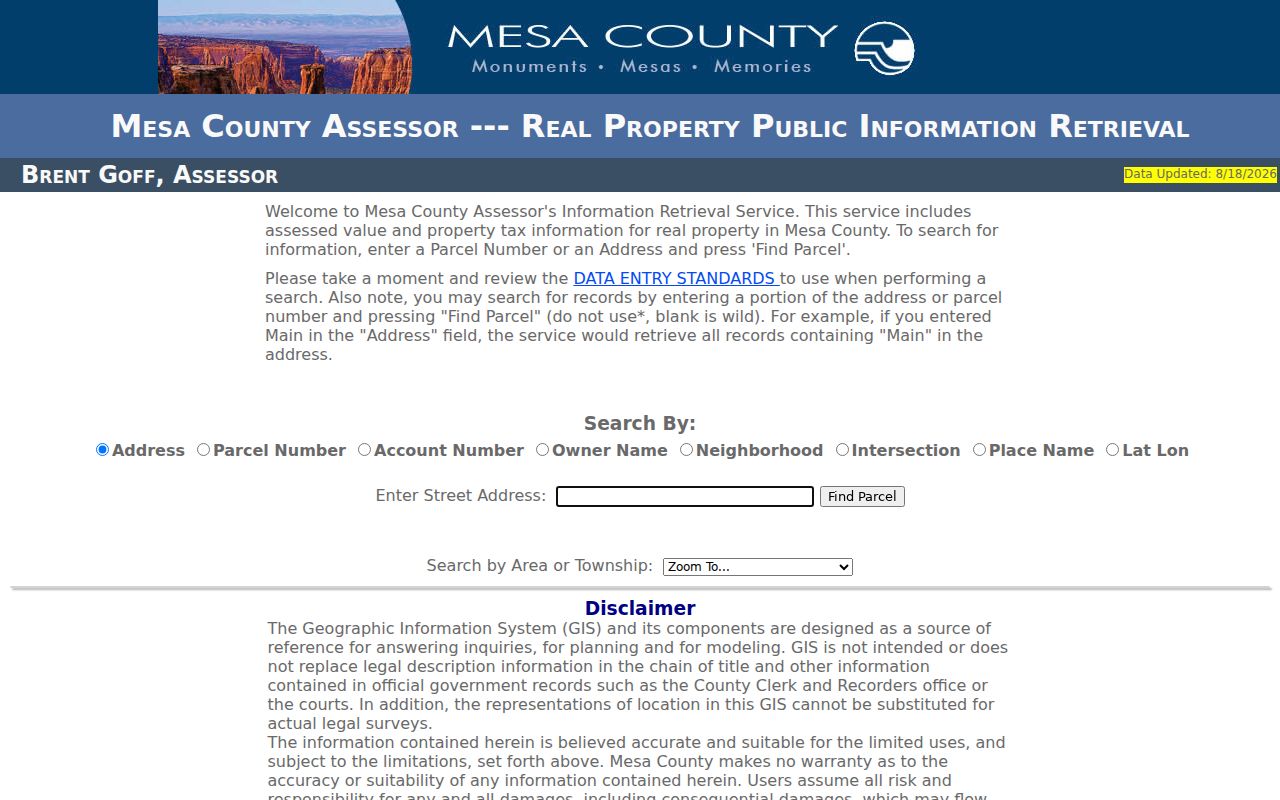
The capture shows a parcel lead, not a promise of present occupancy.
Grand Junction Recorded Resident Trails
Mesa Landmark is the recorded-document trail for Grand Junction. Its name search exposes party type, name, book type, document type, document category, town, a date range or recent period, and a result limit. Other tabs take book and page, sales price or documentary fee, reception number, record date, legal text, or quick search. Controls are simple. Submit, Clear Form, and Clear All sit on screen, and legal search accepts starts, contains, or equals.
A Grand Junction residents directory built from filings needs care. Recorded documents do not all mean the same thing. Liens, marriage licenses, plats, deeds of trust, easements, and releases carry different weight. A grantor conveys or releases an interest. A grantee receives one. The reception number identifies the recorded filing itself. Treat the index as a lead, never the instrument. Online records run from 1883 to the present, and the pre-1969 image route may require a reception number.
Keep a small ledger as you work. Note the search name, town, date range, document type, reception number, recorded date, book or page, parties, legal description, and image status. For an important result, compare its legal description with the assessor parcel and the prior or next instrument. Office copies remain the official fallback. Ordinary copies list at $.25 per page, plats carry size-based prices, and certification is a separate charge.
| Landmark field | Why it matters | Search note |
|---|---|---|
| Party name | Finds a person, trust, estate, or organization on a filing. | Try name order and spelling variants. |
| Document type | Separates deed, lien, easement, correction, or other filing. | Use category and town when known. |
| Reception number | Connects the index row to a recorded filing or older image route. | Especially useful for pre-1969 images. |
| Legal text | Tests the described land against a parcel or plat. | Use starts, contains, or equals. |
The Mesa Landmark search is worth opening before any Grand Junction resident lookup. It exposes several routes instead of forcing every address question into a name search.
Grand Junction Voter Lookup
The Colorado Secretary of State voter lookup is a narrow confirmation tool. It is not a downloadable Grand Junction residents directory. It asks for first name, last name, and ZIP. It also needs a birthday split into month, day, and year. The state suggests trying a former ZIP after a move. It also gives a separate instruction for a one-name record. A confidential record or an under-18 record may not appear. Unresolved cases get routed to the county clerk.
Colorado voter data mixes public and protected fields. A permitted public record may include name, residential address, and party affiliation with its date. It may also cover a phone number if supplied, gender identity if supplied, birth year, and whether the person voted in prior elections. Social Security and driver's-license numbers stay protected. So do month and day of birth, signatures, email, and confidential addresses. Ballot choice is not voter-registration data at all.
Mesa County keeps a separate report form for defined reports, not casual ZIP-wide searches. It lists report codes for district or precinct information, joined voter history, and registered lists. Walking lists are included too. Requesters pick district, precinct, party, status, phone inclusion, delivery, and payment. The form lists $35 reports, map charges, and a certificate charge. It also covers secure-email Excel delivery and a stated three-business-day process. Ordinary lists omit confidential voters.
Open the Official Colorado Voter Lookup to compare the required fields with the capture below.
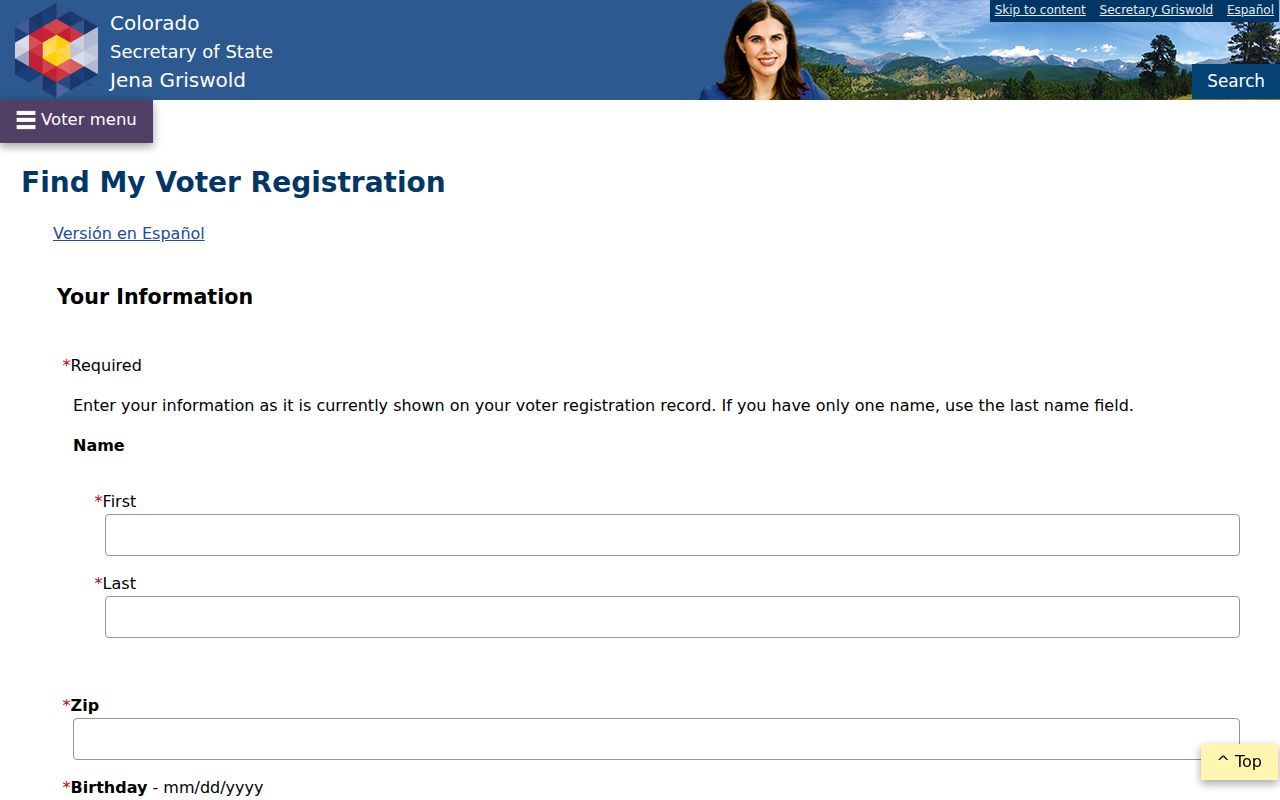
The screenshot shows the individual fields one at a time. A failed match can mean a protected record, a changed ZIP, a spelling difference, or a filter issue. It does not mean the address is empty.
Interpretation rule. A voter result confirms what the election system displays for that search. It does not prove that every person at an address is registered there or that a protected record does not exist.
Current Grand Junction Resident Sources
Each current source in this Grand Junction residents directory answers a different slice of the question. Each one covers something different. The assessor keeps the parcel angle. Landleigh instruments aside, the county's Landmark system works from recorded documents. Voter tools track registration instead. Short sentences matter here. The city cemetery search offers an interment clue. City Clerk WebDrawer may surface a permit, ordinance, license, or file tied to an address. Knowing what a result can actually prove keeps a resident lookup honest. That keeps anyone from reading too much into it.
| Source | Record relationship | Keeper | Access |
|---|---|---|---|
| Assessor parcel report | Current parcel, location, mailing, and displayed owner fields | Mesa County Assessor | Public lookup, report date, planning disclaimer |
| Landmark index | Parties, dates, document types, legal text, and reception leads | Mesa Clerk and Recorder | Free online view, copy and certification charges |
| Voter lookup | Individual registration and polling route | Colorado SOS and Mesa Elections | Birthday and ZIP fields; confidentiality limits |
| City WebDrawer | Indexed municipal records and supporting-document metadata | Grand Junction City Clerk | Custom criteria, exact string, and sort controls |
| Cemetery search | Name, interment year, and cemetery clue | City of Grand Junction | Public search; digitization is ongoing |
These rows can be joined by address, parcel, name, date, or record number, but write the join down. A city permit is not a voter record. A cemetery result is not a current address. A WebDrawer item can be historic even when the address still exists. When a person-specific question remains unresolved, climb the name and record ladder rather than treating these rows as one list.
Grand Junction Courts and Vital Records
The Colorado Judicial Branch docket search can narrow a name to a Mesa County hearing. Filters cover district, county, courthouse, court type, division, date, case year, class, sequence, party or business, attorney, and bar number. At least one non-date filter is required. A result can show date, time, duration, name, case number, hearing type, location, appearance type, and courtroom. Remember what it is. It remains a hearing calendar, not a disposition or a complete case file. Open the Mesa County docket search before comparing the public hearing layer in the capture below.
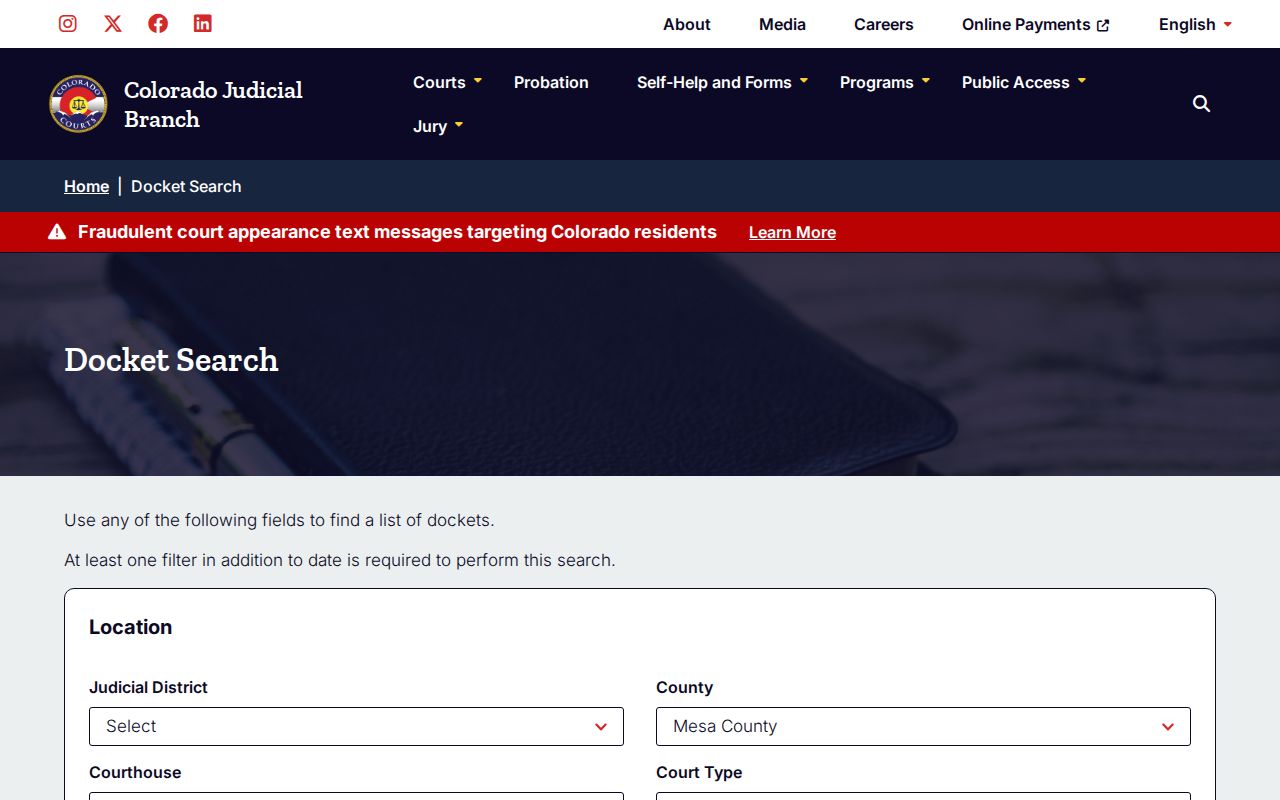
The page shows the public hearing layer. For the actual document, use the court request form. Preserve the case number, county, case type, requested document, restriction proof, and response estimate.
Vital records follow a different rule. Colorado describes birth, death, adoption, marriage, and divorce records as confidential. Some are restricted by record type and eligibility. Mesa Public Health lists birth access for all Colorado counties. The state or county route handles it. Mesa death coverage runs from 1910 forward, and a statewide death route starts in 1975. The 2026 Mesa fee is $25 for the first certified copy. Each additional copy costs $20. Identity and eligibility proof are required.
Open the Mesa birth and death certificate route before comparing access paths.

Court and vital records in Grand Junction arrive by mail, email, or online depending on the office. Marriage applications sit with the county clerk, while divorce files belong to the district court and older material rests at the State Archives. Cemetery results are easier to reach, though digitization still leaves gaps.
Rashleigh Room Grand Junction History
The Rashleigh Regional History Room sits downstairs at Mesa County Libraries' Central Library, 443 N. 6th Street, and it anchors any Grand Junction resident lookup with deep historical roots. Inside, you'll find microfilm readers and city directories. Grand Junction News material, recent Daily Sentinel PDFs, a digital-conversion station, and public computers are there too. The room is a working research hub. Its holdings reach surprisingly far back. Daily Sentinel microfilm runs from 1893 to the present. Meanwhile, the Colorado Historic Newspapers Collection covers an 1893 to 1914 Sentinel run plus newspapers across the state. Grand Junction News material spans 1883 to 1893 through a library newspaper route. Ask staff about image and OCR availability when you visit.
The Mesa genealogy research guide is the best first stop. It maps the full chain of shelf, microfilm, and research help. One-on-one assistance is available, and database access varies by location. Ancestry Library Edition and FamilySearch work inside the library. HeritageQuest works from home with a library card. A practical habit for past residents of Grand Junction: search by issue date and page. Then test each newspaper clue against a cemetery, court, deed, or eligible vital record before treating it as fact.
Historical Grand Junction Directories
No single directory run covers Grand Junction's past. Several overlapping collections hold pieces of it instead. Mesa County Libraries places local directories back to 1902 through Ancestry and physical holdings. A city historic survey describes Polk's Grand Junction City Directory from 1904 to 1975. The History Colorado catalog lists Polk material spanning roughly 1935 to 1973. It also includes Mesa County and nearby locality notes. A National Archives guide adds Grand Junction and Mesa County holdings. The years covered are 1930 to 1932 and 1935.
A city directory entry can carry a name, street, occupation, spouse, office, and business partner. It sometimes even carries a forwarding or death note. Gaps appear too. The 1912 issue lacks an address section. No complete official reverse or criss-cross run exists for the city. Search the name index first. Then inspect the page image itself. Treat an office address as an office clue, not a home. Publisher labels, shelf locations, and year gaps matter as much as any search box.
The dedicated Grand Junction city directories page lays out collection years, shelf locations, and entry fields. It also covers a household-tracing method.
Grand Junction Road Name Traps
Street names carry part of the record key in Grand Junction. In the original townsite, Main splits north from south and First splits east from west. Numbered roads generally run north and south. Lettered roads run east and west. Historic addresses may rely on grid or townsite language rather than a modern ZIP. The city index pairs Unaweep Avenue with C Road. It also matches North Avenue with Highway 6 Bypass, Patterson Road with F Road, Broadway with State Highway 340, and 32 Road with State Highway 141.
Renames complicate things further. Mesa Planning recorded the C Road to Unaweep Avenue change on November 14, 2024. The change runs from Highway 50 east to 29 Road. Orchard Mesa poses its own problem. An official city survey says annexation began in 1966. Older directory addresses there can be irregular. Keep the old spelling, normalized spelling, city or county label, and source year together. A ZIP layer alone cannot repair a historic alias.
The Grand Junction by-street walkthrough carries the full address-keyed workflow. It spans assessor standards and GIS layers, permits, deeds, voter context, and the limits of a street record.
Grand Junction Business Clues
A public trail can surface through an organization, trade name, UCC notice, or professional license. It rarely proves where someone lives or what role they hold today. The Colorado Secretary of State business search takes a business name, trademark, trade name, ID, or document query. Advanced fields cover filing dates, exact-match options, registered-agent and registrant names, and organization names. Results are filed registry records carrying their own status and event dates.
Colorado DORA's license lookup works differently. It accepts license type, prefix and number. It also takes individual or business name, maiden name, city, state, and ZIP. A detail may show status, issue or expiration dates, and public actions. Check the profession-specific board and date. A registered agent or licensee is not automatically the current operator of an organization.
Start with the Colorado Secretary of State search itself. The route is filing-oriented, not a people directory.
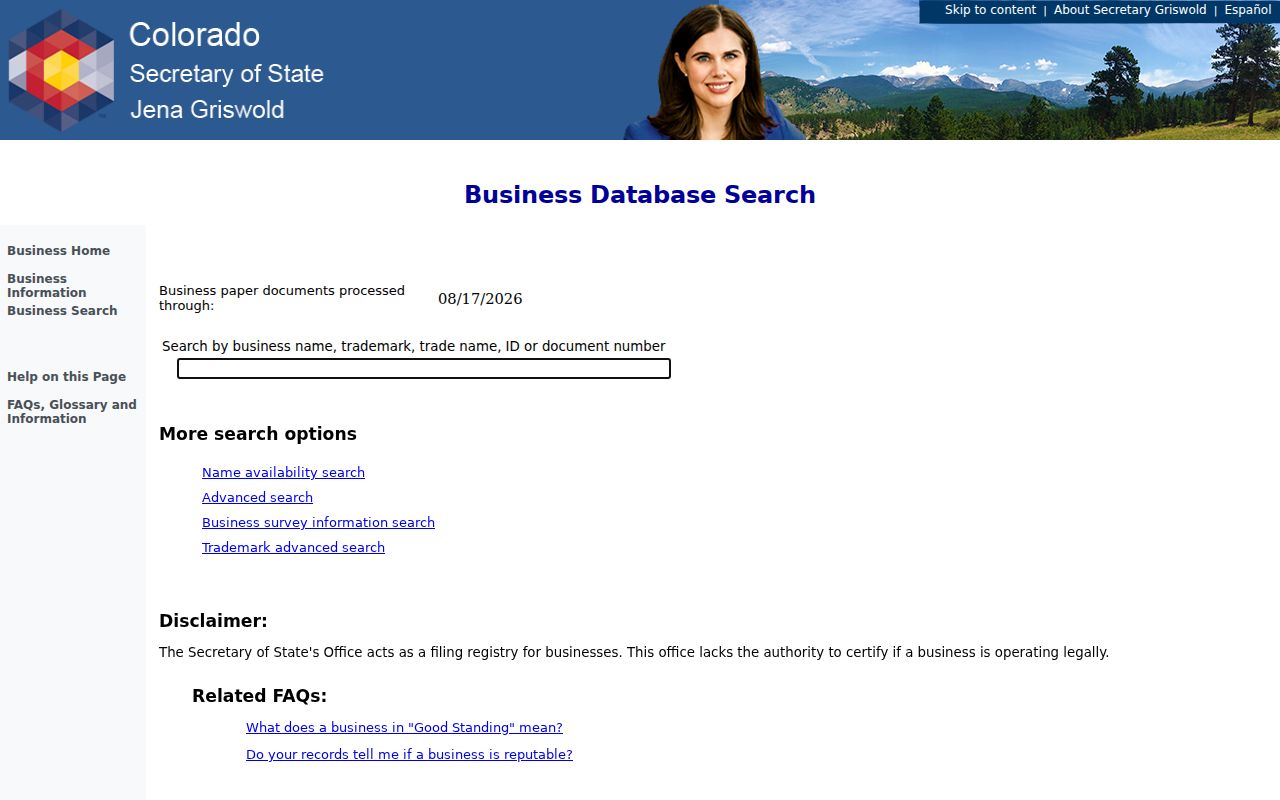
The official search page shows the filing record itself. This helps separate an entity from any address or resident conclusion. Preserve the filing date, entity ID, name, status, and registered-agent field when that is the record question.
The Great Colorado Payback adds another name and ZIP clue through unclaimed property. It has its own claim process. Open that Treasury search directly and test name and former-ZIP variants there.
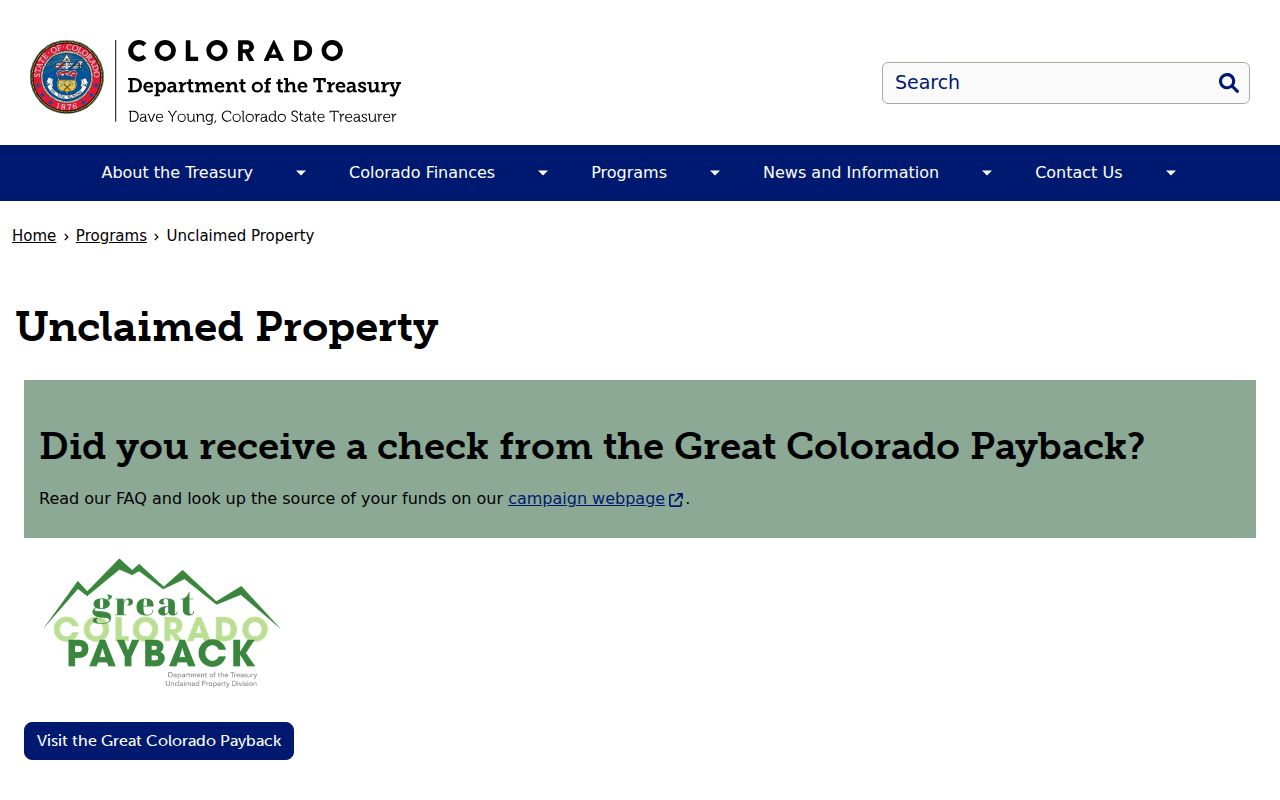
The capture can point to a claim workflow, not proof of a current address.
Grand Junction Block Maps
Maps can anchor a resident clue in real geography. Mesa GIS layers parcels, zoning, districts, schools, floodplains, utilities, and more. The city viewer covers property, zoning, parks, public safety, transportation, and ZIP areas. Neither is a household roster. They are planning tools, not a legal survey. They will not name who lives at an address in Grand Junction.
The county's metadata also tracks neighborhood, watch, and association polygons. Those are fed by Planning, Community Development, and Police databases. That layer refreshes nightly. Source descriptions date to roughly 2009 and 2014. City records from 2017 list Lincoln Park and Emerson Park as non-binding association applications. The minutes put Lincoln Park at about 110 residences. Those papers show an association process existed, not a current member list.
Treat block maps as a starting point only. They cannot reveal a private household member or a protected voter. They cannot reveal a utility customer or a DMV address. Find the parcel and the jurisdiction first. Then ask the named custodian for the public record that answers the question.
Use records for a lawful personal purpose. A public map or roll is not permission to stalk, harass, intimidate, or harm anyone. Protected addresses and restricted records must remain protected.
Grand Junction Records Request Checks
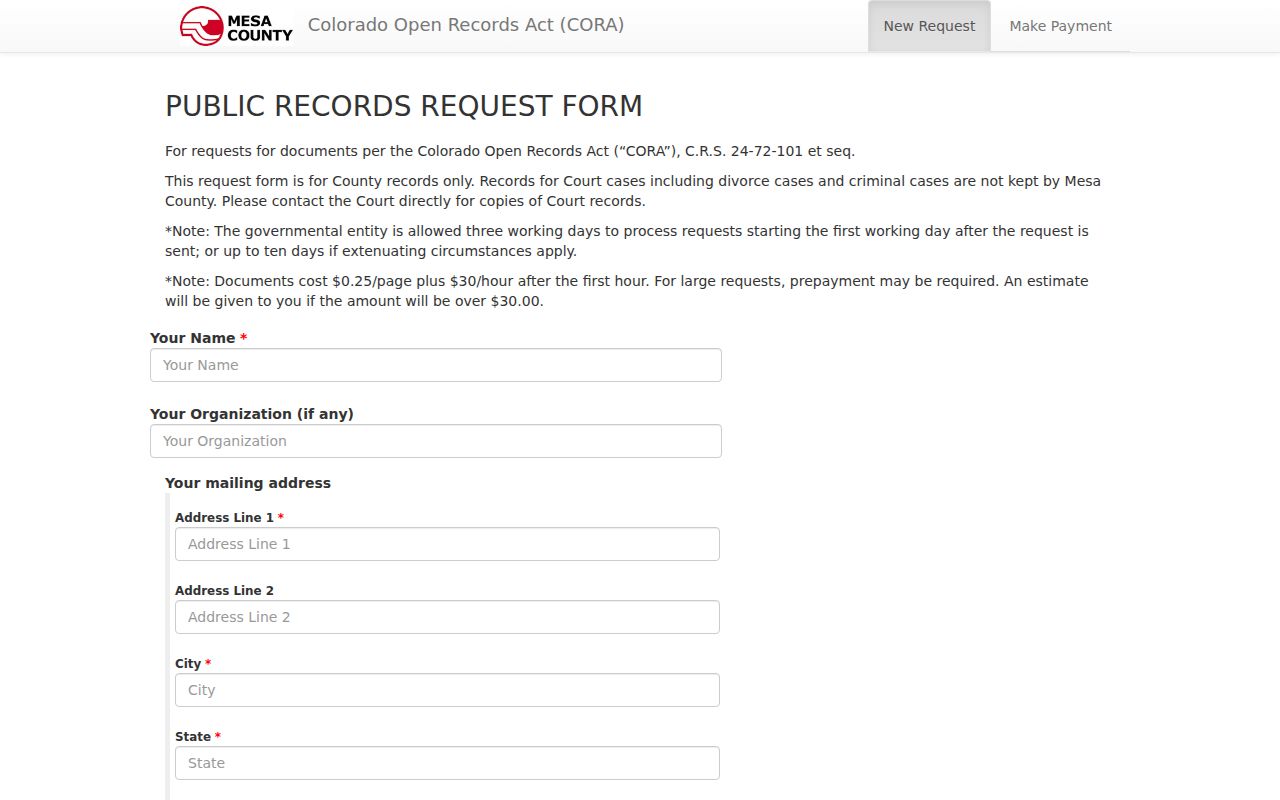
No public search on a portal is not the end. Ask the custodian directly for an existing record set. Narrow it by name, address, parcel, topic, and date range. Mesa County's CORA form wants your contact details, the records, a date range, a copy choice, and delivery by email, mail, or pickup. Three working days is the county's stated norm, with extra time allowed for extenuating circumstances. Pages run $.25, and labor charges kick in after the first hour. The city form seeks record type or topic, dates, names, locations, and preferred delivery. Its policy allows three working days plus a possible seven-working-day extension.
Open the Mesa County CORA request first. It is the fallback whenever a residents directory index stops short.
Scammers impersonate records offices. Verify any payment message against the official agency domain and a known phone number. City warnings cite fake fines and jury-duty notices. Other scams involve gift-card demands. Officials also warn of bank impersonation and demands for passwords or one-time codes.
Keep a file on every request. Log the request number, fee estimate, response date, delivery choice, redactions, and the custodian's explanation. That trail turns a broad residents directory question into something you can actually track.