
Finding Grand Junction Residents
A useful resident search begins by naming the question. An address question belongs first with the Mesa County Assessor Property Lookup and the county GIS viewer. A question about a scheduled hearing belongs with the Colorado Judicial Branch docket, while an eligible birth or death request belongs with Mesa County Public Health. A historical question may be answered by a city directory, newspaper page, cemetery result, or Sanborn map rather than by a current roll.
Each record uses a different relationship to a person. An assessor card can show a parcel, location, mailing address, and the owner fields the interface displays. A recorded deed shows a party on an instrument. A voter lookup is an individual confirmation tool. A directory entry places a person at a time. Those are useful clues, but none should be turned into a claim about a current household without a date and a second source.
A careful starter order keeps the trail readable:
- Write down the full name or exact address, including the city, county, postal ZIP, and any middle initial.
- Use the assessor and GIS tools to identify the parcel, account, jurisdiction, and location address.
- Use the Colorado voter lookup only for an individual confirmation, with first name, last name, ZIP, and birthday fields.
- Search Mesa Landmark by party, legal description, reception number, or document date when an instrument matters.
- Move to the library, archives, or a focused records request when the public portal ends.
Offices Behind Grand Junction Residents
Grand Junction is the incorporated county seat inside Mesa County, so the right custodian depends on the record and the boundary. The Mesa County Clerk and Recorder handles recorded instruments, elections, and marriage-license work. The Assessor and GIS teams provide parcel and district context. Grand Junction's City Clerk keeps municipal records in WebDrawer and routes unindexed material through the city's public-record process. Courts, Public Health, libraries, and the State Archives hold separate collections.
Mesa County Recording Division
200 S. Spruce Street
Grand Junction, CO 81501
970-244-1679
Mesa County Elections
200 S. Spruce Street
Grand Junction, Colorado
970-244-1662
For a missing city record, the City Clerk is the first stop. For a missing county record, use the Mesa request form. For a court file, contact the 21st Judicial District custodian. Naming the office before asking for a record prevents a city request from being sent to the county or a vital request from being sent to a court.
Grand Junction Assessor Clues
The Mesa Assessor search is the strongest first move when an address is known. Its tabs accept an address, parcel number, account number, owner name, neighborhood, intersection, place name, or latitude and longitude. The address route has two street inputs plus area or township and neighborhood choices. A blank field acts as a wildcard, but the standards page says not to use an asterisk. If an exact road form fails, the county suggests trying the house number alone and then checking the parcel or account route.
The parcel report separates the physical location from the mailing address and can show property use, owner or joint owner fields, neighborhood, approximate coordinates, legal description, TAC, and previous or associated parcels. That distinction matters. A PO Box or a mailing address in another city is not proof of who occupies the location. The assessor also describes the service as a reference and planning tool, not a survey or chain-of-title source.
The Mesa address standards list forms such as ST, AVE, RD, DR, LN, CT, CIR, WAY, and HIGHWAY. Preserve the source spelling in one field and the normalized form in another.
| Assessor route | Observed search detail |
|---|---|
| Address | Two street inputs, area or township, neighborhood, partial address, or house-number fallback. |
| Parcel number | Dashed parcel format, plus township, range, section, quarter, block, or lot choices. |
| Account number | Account such as R023126, leading to the parcel report and print options. |
| Other tabs | Owner, neighborhood, intersection, place name, and approximate latitude or longitude. |
The county research sample shows why a result needs context: a parcel card can pair a physical location with a separate PO Box mailing address. Record both fields and the report date instead of calling either one a resident list.
For a visual view of parcel and jurisdiction layers, use the Mesa County GIS viewer after the assessor search.
Assessor pages in the research snapshot carried update dates from late July to mid-August 2026, while related systems update on their own schedules.
Open the Mesa Assessor Property Lookup before reading the capture below; it is the address-centered starting point for a Grand Junction residents directory search.
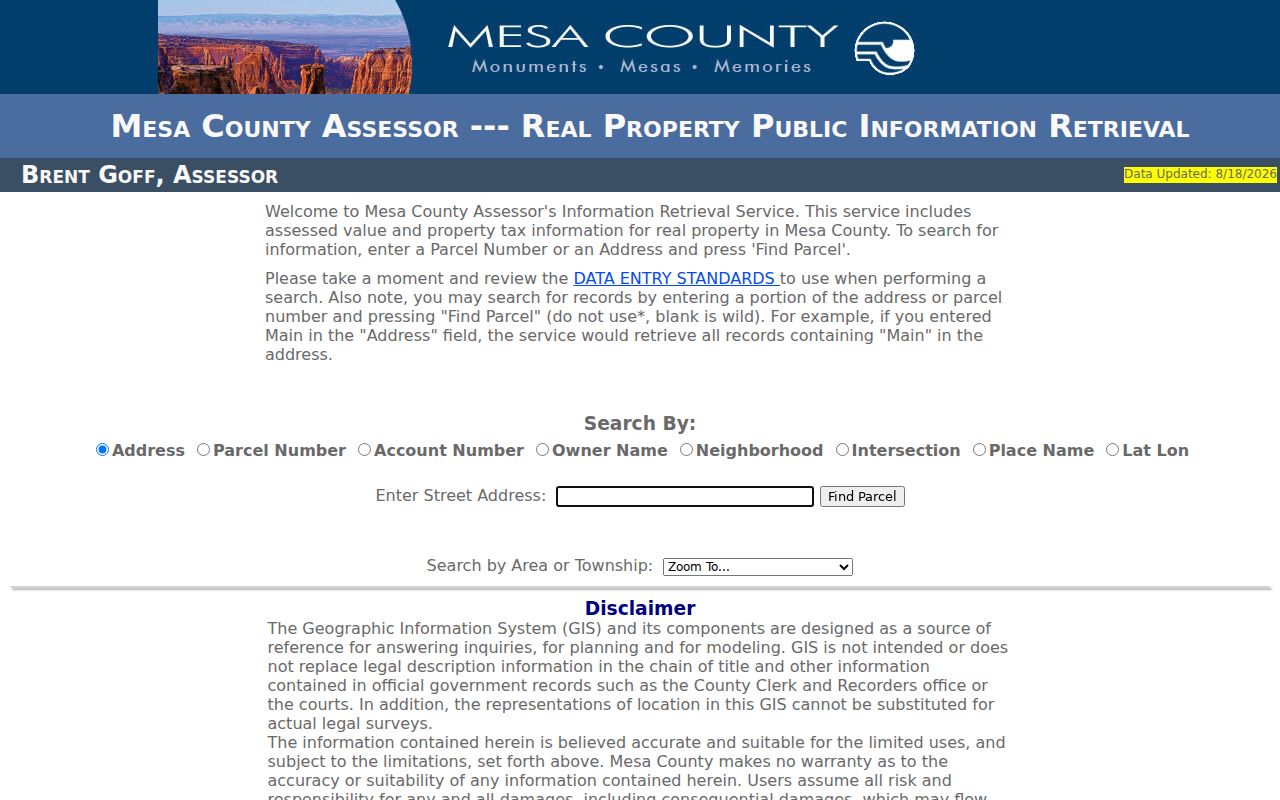
The capture shows a parcel lead, not a promise of present occupancy.
Grand Junction Recorded Resident Trails
Mesa Landmark is the recorded-document trail. Its name search exposes party type, name, book type, document type, document category, town name, date range or recent period, and a result limit. Other tabs use book and page, sales price or documentary fee, reception number, record date, legal text, or quick search. The visible controls include Submit, Clear Form, and Clear All. Legal search can use starts, contains, or equals.
Recorded documents, liens, marriage licenses, plats, deeds of trust, easements, releases, and other filings do not all mean the same thing. A grantor is a party conveying or releasing an interest; a grantee is a party receiving one. A reception number identifies the recorded filing. The index is a lead to the instrument, not the instrument itself. Online records are described as reaching from 1883 to the present, with a pre-1969 image route that may require a reception number.
Keep a small ledger with the search name, town, date range, document type, reception number, recorded date, book or page, parties, legal description, and image status. If the result is important, compare its legal description with the assessor parcel and the prior or next instrument. Office copies remain the official fallback. Ordinary copies are listed at $.25 per page, plats have size-based prices, and certification is a separate charge.
| Landmark field | Why it matters | Search note |
|---|---|---|
| Party name | Finds a person, trust, estate, or organization on a filing. | Try name order and spelling variants. |
| Document type | Separates deed, lien, easement, correction, or other filing. | Use category and town when known. |
| Reception number | Connects the index row to a recorded filing or older image route. | Especially useful for pre-1969 images. |
| Legal text | Tests the described land against a parcel or plat. | Use starts, contains, or equals. |
The Mesa Landmark search image is useful because it exposes several routes instead of forcing every address question into a name search.
Grand Junction Voter Lookup
The Colorado Secretary of State voter lookup is a narrow confirmation tool, not a downloadable Grand Junction residents directory. It asks for first name, last name, ZIP, and birthday as month, day, and year. The state suggests trying a former ZIP after a move and gives a separate instruction for a one-name record. A confidential record or an under-18 record may not appear, and the page routes unresolved cases to the county clerk.
Colorado voter data has public and protected fields. A permitted public record may include name, residential address, party affiliation and date, a phone number if supplied, gender identity if supplied, birth year, and whether the person voted in prior elections. Social Security and driver's-license numbers, month and day of birth, signature, email, and confidential addresses remain protected. Ballot choice is not voter-registration data.
Mesa County's separate report form is for a defined report, not a casual ZIP-wide search. It lists report codes for district or precinct information, joined voter history, registered lists, and walking lists. Requesters choose district, precinct, party, status, phone inclusion, delivery, and payment. The form lists $35 reports, map charges, a certificate charge, secure-email Excel delivery, and a stated three-business-day process. Ordinary lists omit confidential voters.
Open the Official Colorado Voter Lookup to compare the required fields with the capture below.
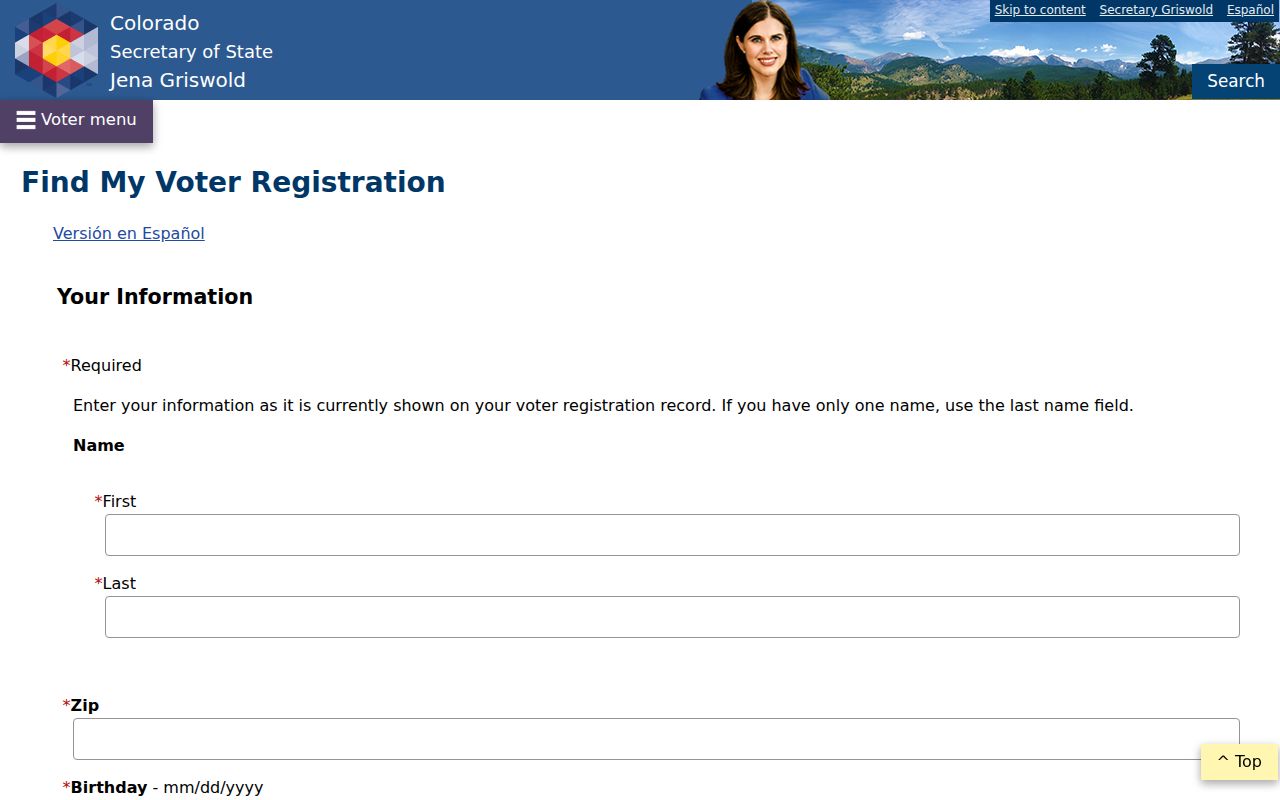
The screenshot illustrates the individual fields. A failed match can mean a protected record, a changed ZIP, a spelling difference, or a filter issue, not an empty address.
Interpretation rule. A voter result confirms what the election system displays for that search. It does not prove that every person at an address is registered there or that a protected record does not exist.
Current Grand Junction Resident Sources
Current records answer different parts of the same question. The assessor is parcel-centered. Landmark is instrument-centered. Voter tools are registration-centered. The city cemetery search is an interment clue, while City Clerk WebDrawer can expose a permit, ordinance, license, or supporting file tied to an address. A useful source map says what a result can prove before anyone reads more into it.
| Source | Record relationship | Keeper | Access |
|---|---|---|---|
| Assessor parcel report | Current parcel, location, mailing, and displayed owner fields | Mesa County Assessor | Public lookup, report date, planning disclaimer |
| Landmark index | Parties, dates, document types, legal text, and reception leads | Mesa Clerk and Recorder | Free online view, copy and certification charges |
| Voter lookup | Individual registration and polling route | Colorado SOS and Mesa Elections | Birthday and ZIP fields; confidentiality limits |
| City WebDrawer | Indexed municipal records and supporting-document metadata | Grand Junction City Clerk | Custom criteria, exact string, and sort controls |
| Cemetery search | Name, interment year, and cemetery clue | City of Grand Junction | Public search; digitization is ongoing |
These rows can be joined by an address, parcel, name, date, or record number, but the join must be written down. A city permit is not a voter record. A cemetery result is not a current address. A WebDrawer item can be historic even when the address still exists. When a person-specific question remains unresolved, use the name and record ladder rather than treating these rows as one list.
Grand Junction Courts and Vital Records
The Colorado Judicial Branch docket search can narrow a name to a Mesa County hearing. Filters include district, county, courthouse, court type, division, date, case year, class, sequence, party or business, attorney, and bar number. At least one non-date filter is required. A result can show date, time, duration, name, case number, hearing type, location, appearance type, and courtroom. It remains a hearing calendar, not a disposition or complete file.
Open the Mesa County docket search before comparing the public hearing layer in the capture below.
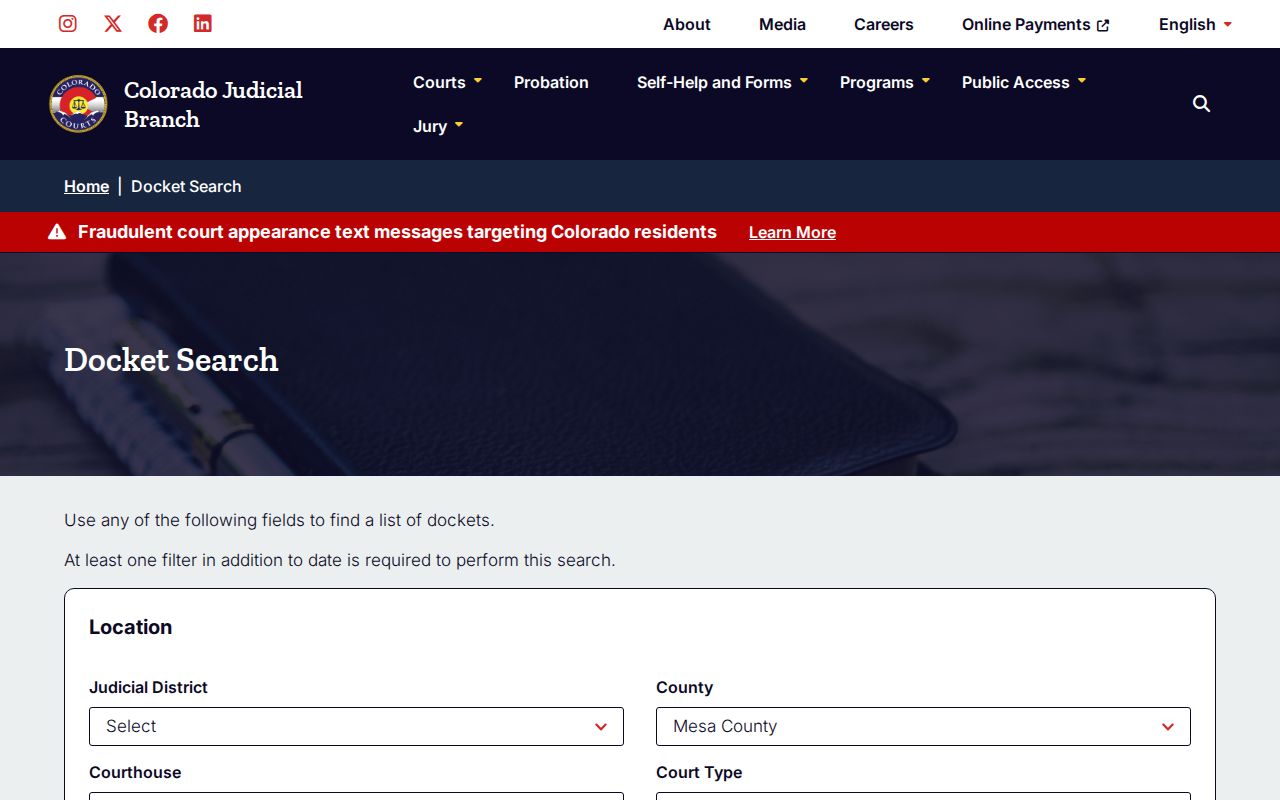
The capture shows the public hearing layer. For the actual document, use the court request form and preserve the case number, county, case type, requested document, restriction proof, and response estimate.
Vital records follow a different rule. Colorado describes birth, death, adoption, marriage, and divorce records as confidential or restricted by record type and eligibility. Mesa Public Health lists birth access for all Colorado counties through the state or county route, Mesa death coverage from 1910 forward, and a statewide death route from 1975 forward. The 2026 Mesa fee is $25 for the first certified copy and $20 for each additional copy. Identity and eligibility proof are required.
Open the Mesa birth and death certificate route before using the capture below to compare its access paths.

The route explains online, email, and mail options. Marriage applications belong to the county clerk, divorce files to the district court, and historic material to the State Archives. A cemetery result is more open, but digitization can leave gaps.
Rashleigh Room Grand Junction History
The downstairs Rashleigh Regional History Room at Mesa County Libraries is a key historical resident source. The Central Library at 443 N. 6th Street lists microfilm readers, Daily Sentinel and Grand Junction News material, city directories, a digital-conversion station, public computers, and recent Daily Sentinel PDFs. The library's genealogy guide also points to one-on-one help, Ancestry Library Edition inside the library, HeritageQuest from home with a library card, and FamilySearch in the library.
The Daily Sentinel microfilm is described as 1893 to the present. The Colorado Historic Newspapers Collection includes a 1893 to 1914 Daily Sentinel run and broad Colorado coverage. Grand Junction News material from 1883 to 1893 is identified through a library newspaper route, but image and OCR availability should be checked at the time of use. Search issue date and page, then compare a newspaper clue with a cemetery, court, deed, or eligible vital record.
Library access changes by database. The Mesa genealogy research guide is the best starting point for the shelf, microfilm, and research-help chain.
Historical Grand Junction Directories
Grand Junction's historical directory trail has several overlapping claims rather than one perfect run. Mesa County Libraries says local directories reach back to 1902 through Ancestry and physical collections. A city historic survey describes Polk's Grand Junction City Directory from 1904 to 1975. The History Colorado catalog describes Polk material around 1935 to 1973, with Mesa County and nearby locality notes. A National Archives guide lists Grand Junction and Mesa County holdings for 1930 to 1932 and 1935.
A city directory can show a name, street, occupation, spouse, office, business partner, and sometimes a forwarding or death note. It can also fail. The 1912 issue lacks an address section, and the research did not locate a complete official reverse or criss-cross run. Search the name index, inspect the page image, and treat an office address as an office clue. The physical collections, publisher labels, and year gaps matter as much as a search box.
Use the dedicated Grand Junction city directories page for the collection years, shelf locations, entry fields, and a household-tracing method.
Grand Junction Road Name Traps
Street names are part of the record key. In the original townsite, Main divides north and south while First divides east and west. Numbered roads generally run north and south, lettered roads east and west, and historic addresses may use grid or townsite language instead of a modern ZIP. The city index pairs Unaweep Avenue with C Road, North Avenue with Highway 6 Bypass, Patterson Road with F Road, Broadway with State Highway 340, and 32 Road with State Highway 141.
Mesa Planning recorded the C Road to Unaweep Avenue rename from Highway 50 east to 29 Road on November 14, 2024. Orchard Mesa also has a distinct research problem: an official city survey says annexation began in 1966 and older directory addresses can be irregular. Keep the old spelling, normalized spelling, city or county label, and source year together. The visual ZIP layer cannot repair a historic alias by itself.
The Grand Junction by-street walkthrough carries the full address-keyed workflow, including assessor standards, GIS layers, permits, deeds, voter context, and the limits of a street record.
Grand Junction Business Clues
A person can leave a public clue through an organization, trade name, UCC notice, or professional license without that filing proving a current home or current role. The Colorado Secretary of State business search accepts business name, trademark, trade name, ID, or document searches. Advanced fields include filing dates, exact-match choices, registered-agent and registrant names, and organization names. Results are filed registry records with their own status and event dates.
Colorado DORA's license lookup accepts license type, prefix and number, individual or business name, maiden name, city, state, and ZIP. A detail may show status, issue or expiration, and public actions, but the research did not verify the full current result layout. Check the profession-specific board and date. A registered agent or licensee is not automatically the current operator of an organization.
Open the Colorado Secretary of State search before viewing the capture below; the route is filing-oriented, not a people directory.
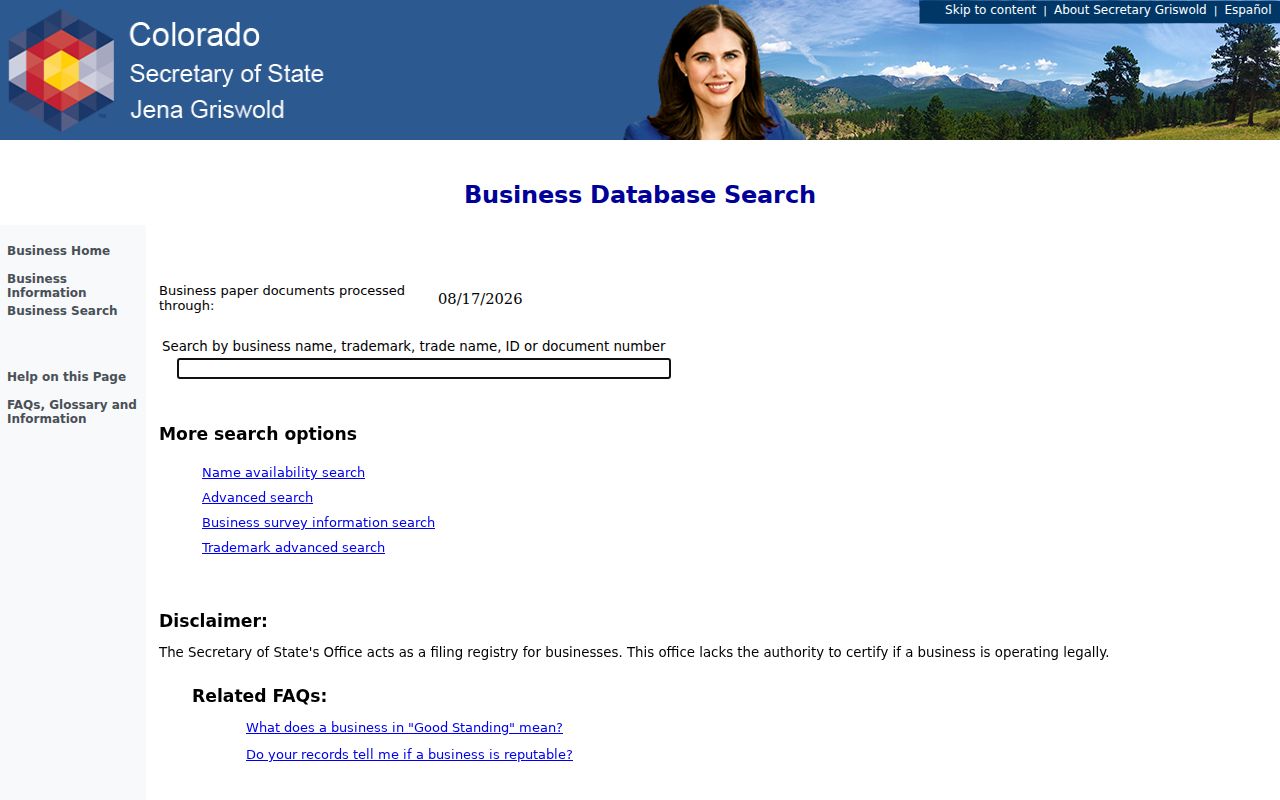
The official capture helps separate an entity filing from an address or resident conclusion. Preserve the filing date, entity ID, name, status, and registered-agent field if that is the record question.
The Great Colorado Payback search is another name and ZIP clue for unclaimed property, with a separate claim process. Open that official Treasury route before using the capture below to check name and former-ZIP variants.
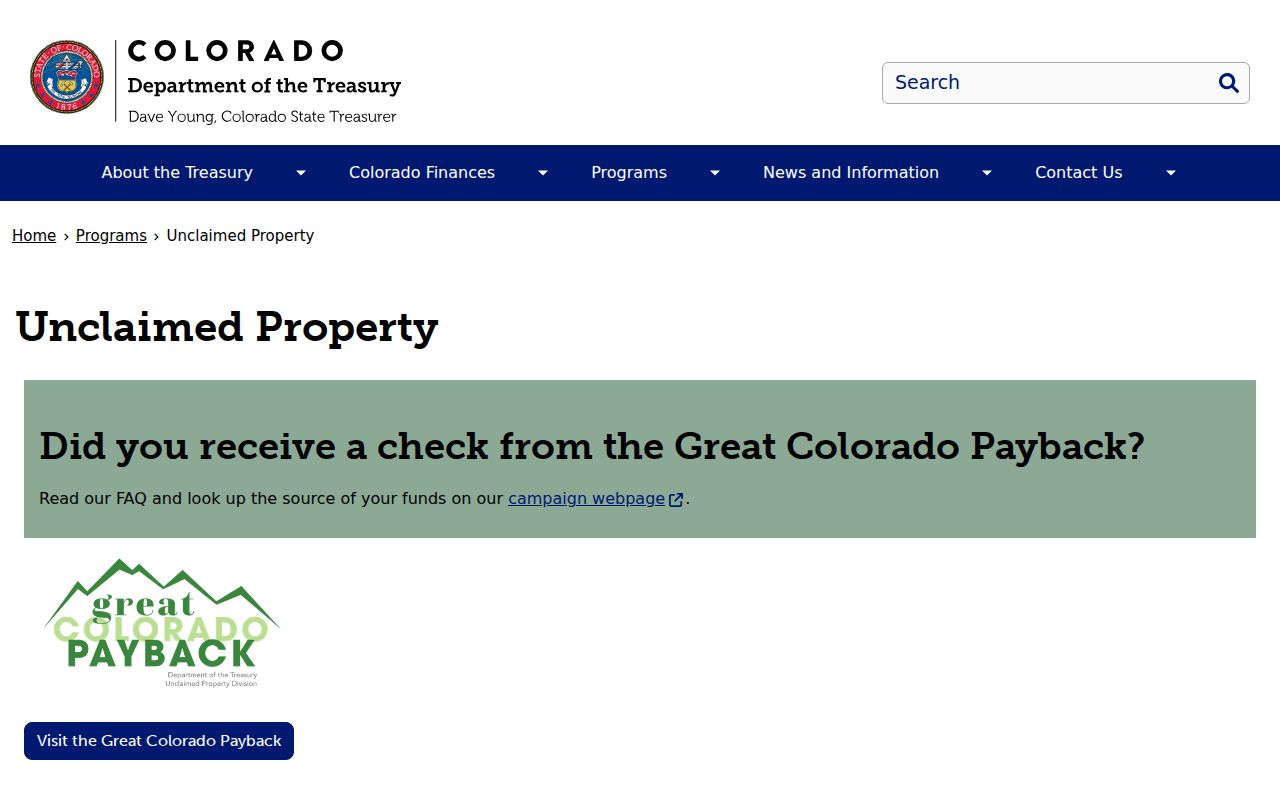
The capture can point to a claim workflow, not proof of a current address.
Grand Junction Block Maps
Mesa GIS and the city GIS map can add useful geography around a resident clue. The county viewer exposes parcel, zoning, district, school, political, service-provider, floodplain, wildfire, transportation, utility, and other layers. The city map includes property, zoning, parks, public safety, transportation, utilities, and ZIP areas. These are map and planning layers, not a public household roster or a legal survey.
City metadata describes neighborhood, neighborhood-watch, and association polygons sourced from Planning, Community Development, and Police databases. The layer is compiled nightly, with source origins described around 2009 and 2014. Lincoln Park and Emerson Park appear in 2017 city records as non-binding neighborhood association applications; the minutes describe Lincoln Park as about 110 residences. That is evidence of an association process, not a current member list.
Do not infer a private household member, protected voter, utility customer, or DMV address from a block map. Use the map to identify parcels and jurisdiction, then return to the named custodian for the public field that answers the question.
Use records for a lawful personal purpose. A public map or roll is not permission to stalk, harass, intimidate, or harm anyone. Protected addresses and restricted records must remain protected.
Grand Junction Records Request Checks
When a portal has no public search, ask the custodian for an existing record set with a narrow name, address, parcel, topic, and date range. Mesa County's CORA form asks for requester contact details, records, date range, copy choice, and email, mail, or pickup delivery. The county describes three working days as typical, with possible extra time for extenuating circumstances, $.25 pages, and labor charges after the first hour. The city form asks for record type or topic, dates, names, locations, and preferred delivery; its policy lists three working days and a possible seven-working-day extension.
Open the Mesa County CORA request before using the capture below; it is the fallback when an index stops.
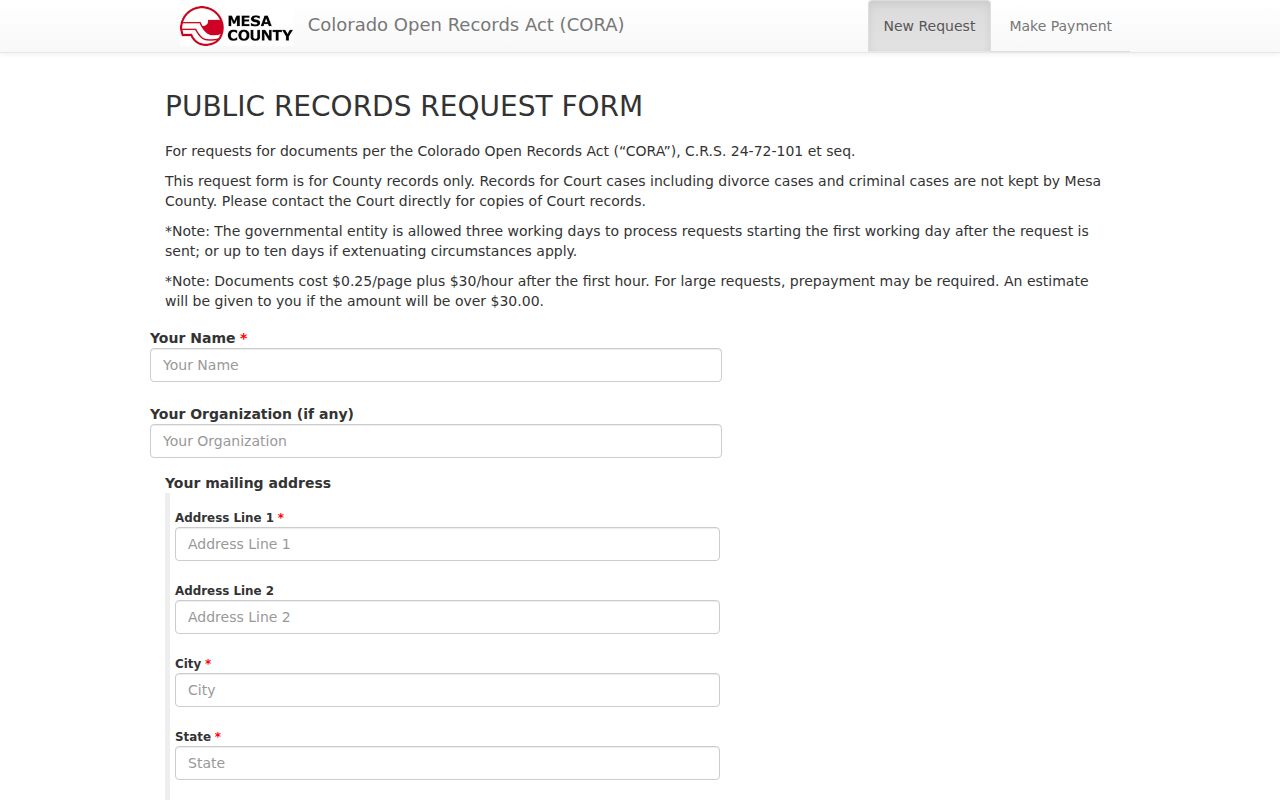
Verify any payment message through the official agency domain and known phone number. City warnings describe fake fines, jury-duty notices, gift-card demands, bank impersonation, and requests for passwords or one-time codes.
Keep the request number, fee estimate, response date, delivery choice, redactions, and custodian explanation. That log turns a broad resident question into a traceable record trail.